Generative Adversarial Network (GAN)
Phase 1: Train the discriminator
- Real images (labeled 1) are combined with fake images (labeled 0). The discriminator is trained to distinguish real from fake. Backpropagation only updates the discriminator weights.
Phase 2: Train the generator
- Produce fake images with generator. Feed only these fake images to discriminator with labels 1. The discriminator will realize these images are fake. This will cause the generator to get better at forging images that the discriminator believes are real. In this step backpropagation only updates the generator weights.
GAN full example:
- The data:
from tensorflow.keras.datasets import mnist
(X_train, y_train), (X_test, y_test) = mnist.load_data()
only_zeros = X_train[y_train==0]
- The model:
import tensorflow as tf
from tensorflow.keras.layers import Dense, Reshape, Flatten
from tensorflow.keras.models import Sequential
- Discriminator:
discriminator = Sequential()
discriminator.add(Flatten(input_shape=[28,28]))
discriminator.add(Dense(150,activation='relu'))
discriminator.add(Dense(100,activation='relu'))
discriminator.add(Dense(1,activation='sigmoid'))
discriminator.compile(loss='binary_crossentropy',optimizer='adam')
- Generator
codings_size = 100

generator = Sequential()
generator.add(Dense(100,activation='relu',input_shape=[codings_size]))
generator.add(Dense(150,activation='relu'))
generator.add(Dense(784,activation='relu'))
generator.add(Reshape([28,28]))
-
Note that we compiled the discriminator but not the generator, because the generator itself is trained through the full GAN model.
-
GAN:
GAN = Sequential([generator,discriminator])
discriminator.trainable = False
GAN.compile(loss='binary_crossentropy',optimizer='adam')
- Training batches
batch_size = 32
my_data = only_zeros

dataset = tf.data.Dataset.from_tensor_slices(my_data).shuffle(buffer_size=1000)
dataset = dataset.batch(batch_size,drop_remainder=True).prefetch(1)

epochs = 10

generator, discriminator = GAN.layers

for epoch in range(epochs):
    print('Currently on epoch {}'.format(epoch))

    i = 0

    for X_batch in dataset:
        i = i+1

        if i%50 == 0:
            print('\t currently on batch {}'.format(i))

        # DISCRIMINATOR TRAINING PHASE
        noise = tf.random.normal(shape=[batch_size,codings_size])

        gen_images = generator(noise)

        # Concatenate the fake and real images
        X_fake_vs_real = tf.concat([gen_images,tf.dtypes.cast(X_batch,tf.float32)],axis=0)

        # set the corresponding labels
        y1 = tf.constant([0.0]*batch_size + [1.0]*batch_size)

        discriminator.trainable = True

        discriminator.train_on_batch(X_fake_vs_real,y1)

        # GENERATOR TRAINING PHASE
        noise = tf.random.normal(shape=[batch_size,codings_size])

        y2 = tf.constant([[1.0]]*batch_size)

        discriminator.trainable = False

        GAN.train_on_batch(noise,y2)
- Testing model:
noise = tf.random.normal(shape=[10,codings_size])
images = generator(noise)

fig,ax = plt.subplots(ncols=4,figsize=(11,3))
for i in range(4):
    ax[i].imshow(images[i])
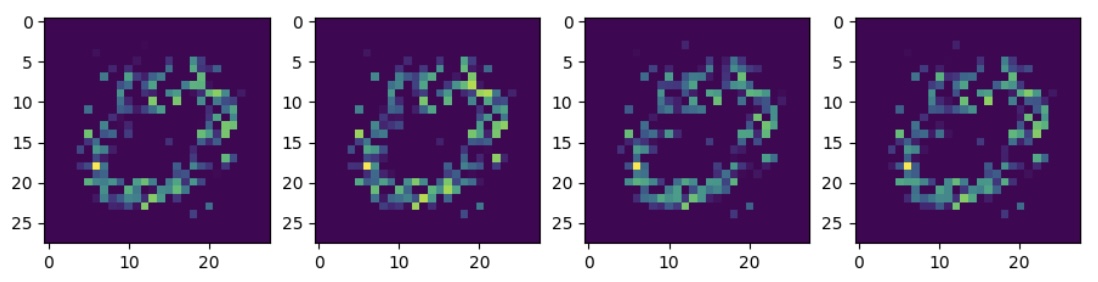
This is an example of mode collapse: these images look very similar. This can be alleviated with Deep Convolutional GANs.
Deep Convolutional GAN:
Most of this code is identical to the one above. The parts that are different will be highlighted below.
- The data:
- Something that we did not do above that we should do here is scale the data. The generator will use tanh activation function for the last layer, so we want to reshape X_train to be within -1 to 1 limits:
X_train = X_train/255
X_train = X_train.reshape(-1,28,28,1)*2.-1.

only_zeros = X_train[y_train==0]
- The model:
import tensorflow as tf
from tensorflow.keras.layers import Dense, Reshape, Flatten, Dropout, LeakyReLU, BatchNormalization, Conv2D, Conv2DTranspose
from tensorflow.keras.models import Sequential
- Discriminator:
discriminator = Sequential()
discriminator.add(Conv2D(64, kernel_size=5, strides=2, padding='same',
                        activation=LeakyReLU(0.3),
                        input_shape=[28,28,1]))
discriminator.add(Dropout(0.5))
discriminator.add(Conv2D(128, kernel_size=5, strides=2, padding='same',
                        activation=LeakyReLU(0.3),
                        input_shape=[28,28,1]))
discriminator.add(Dropout(0.5))
discriminator.add(Flatten())
discriminator.add(Dense(1,activation='sigmoid'))
- Generator:
codings_size = 100

generator = Sequential()
generator.add(Dense(7 * 7 * 128, input_shape=[codings_size]))
generator.add(Reshape([7, 7, 128]))
generator.add(BatchNormalization())
generator.add(Conv2DTranspose(64, kernel_size=5, strides=2, padding="same",
                                 activation="relu"))
generator.add(BatchNormalization())
generator.add(Conv2DTranspose(1, kernel_size=5, strides=2, padding="same",
                                 activation="tanh"))
- GAN:
GAN = Sequential([generator,discriminator])
discriminator.compile(loss='binary_crossentropy',optimizer='adam')
discriminator.trainable = False
GAN.compile(loss='binary_crossentropy',optimizer='adam')
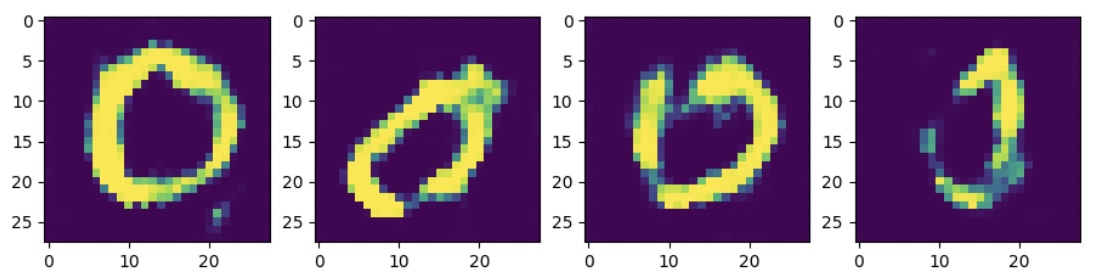
The rest of the code is the same. Now, upon using the generator to create new images, we see a larger variation in the produced zeros: