Autoencoders
Autoencoder for simple 3-feature data
- Instead of the Adam optimizer, with autoencoders we want to use Stochastic Gradient Descent so that we can play with the learning rate.
from tensorflow.keras.models import Sequential
from tensorflow.keras.layers import Dense
from tensorflow.keras.optimizers import SGD
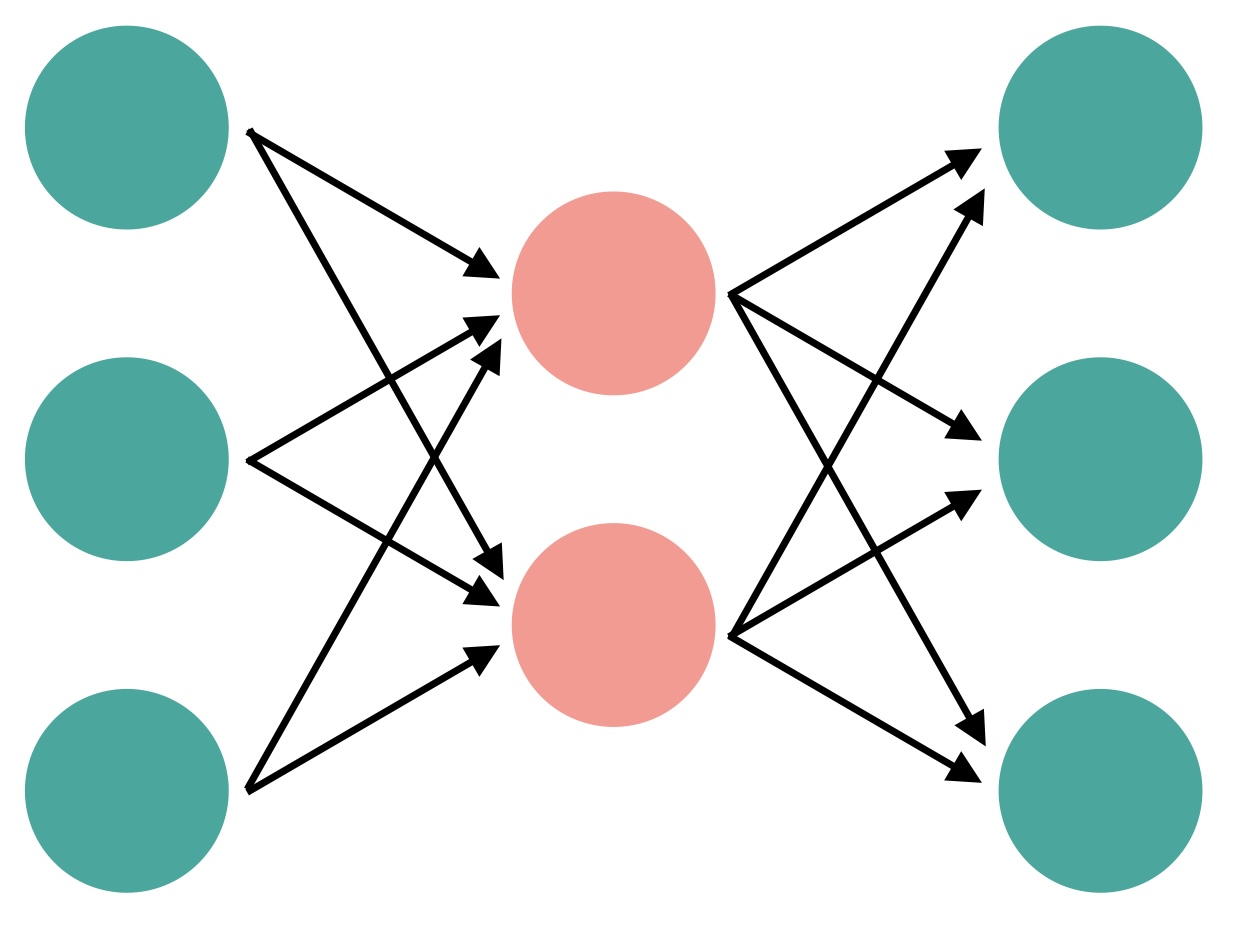
This model will have an encoder that compresses the data from 3 dimensions to 2, and then a decoder that expands from 2 back to 3 dimensions, as shown in the diagram below:
encoder = Sequential()
encoder.add(Dense(2,activation='relu',input_shape=[3]))

decoder = Sequential()
decoder.add(Dense(3,activation='relu',input_shape=[2]))

autoencoder = Sequential([encoder,decoder])
autoencoder.compile(loss='mse',optimizer=SGD(learning_rate=1.5))
We will train both the encoder and decoder together, but then will use the encoder by itself to see the reduced dataset:
from sklearn.preprocessing import MinMaxScaler
scaler = MinMaxScaler()
scaled_data = scaler.fit_transform(data)

autoencoder.fit(scaled_data,scaled_data,epochs=5)
encoded_2dim = encoder.predict(scaled_data)
Autoencoder for image noise reduction
Create and compile the model:
from tensorflow.keras.layers import GaussianNoise

encoder = Sequential()
encoder.add(Flatten(input_shape=[28,28]))
encoder.add(GaussianNoise(0.2)) # Adding noise to input image
encoder.add(Dense(400,activation='relu'))
encoder.add(Dense(200,activation='relu'))
encoder.add(Dense(100,activation='relu'))
encoder.add(Dense(50,activation='relu'))
encoder.add(Dense(25,activation='relu'))

decoder = Sequential()
decoder.add(Dense(50,activation='relu',input_shape=[25]))
decoder.add(Dense(100,activation='relu'))
decoder.add(Dense(200,activation='relu'))
decoder.add(Dense(400,activation='relu'))
decoder.add(Dense(784,activation='sigmoid'))
decoder.add(Reshape([28,28]))

noise_remover = Sequential([encoder,decoder])

noise_remover.compile(loss='binary_crossentropy', optimizer='adam', metrics=['accuracy'])
Fit the model and use it to generate 10 de-noised images:
noise_remover.fit(X_train,X_train,epochs=8)

ten_noisey_images = sample(X_test[:10],training=True)
denoised = noise_remover(ten_noisey_images)
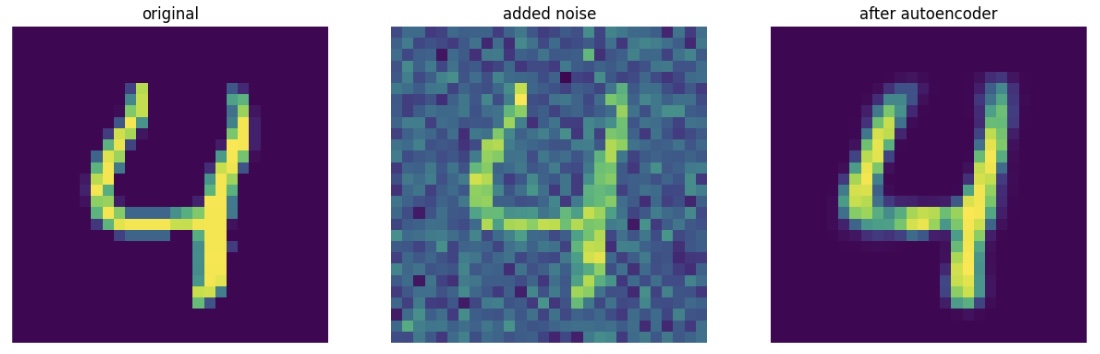
Check the effect on these images:
n = 4
fix,ax = plt.subplots(ncols=3,figsize=(15,5))
ax[0].imshow(X_test[n])
ax[1].imshow(ten_noisey_images[n])
ax[2].imshow(denoised[n])